



Introduction
Search for tulsi essential oil online and you'll find almost every article calling it "the Queen of Herbs" within the first two sentences. That's not wrong, exactly — tulsi does hold a genuinely significant place in Indian culture and Ayurvedic tradition. But if you're trying to figure out whether this oil is actually useful for your stress levels, your skin, or your immune system this winter, the royal titles don't tell you much.
So let's set the ceremony aside for a moment and talk about what tulsi essential oil actually does, what it smells like, how it's different from the basil in your spice rack, and how to use it properly — written specifically with Canadian buyers and Canadian seasons in mind.
One Plant, Two Names, and a Lot of Confusion
"Tulsi" and "Holy Basil" refer to the same plant, but you'll see both names used almost interchangeably across product labels, which can get confusing fast. Botanically, it's most commonly labelled Ocimum sanctum or Ocimum tenuiflorum — and to complicate things further, there isn't just one variety. Several cultivated types exist, each with a slightly different leaf colour, aroma, and traditional use, though most essential oil sold commercially draws from the same general species group.
For the purposes of buying and using the oil, what matters is this: if the label says "Tulsi" or "Holy Basil" and lists Ocimum sanctum or Ocimum tenuiflorum, you're getting the plant this guide is about — not to be confused with the next section's distinction.
Not the Basil in Your Spice Rack — What Makes Tulsi Different
Sweet basil — the kind in your pasta sauce — and holy basil are cousins, both part of the mint family, but they are genuinely different plants with different chemical profiles. Sweet basil essential oil tends to smell bright, green, and slightly peppery. Tulsi oil smells warmer, spicier, and noticeably closer to clove.
That clove-like quality isn't a coincidence — it comes down to chemistry, which we'll get into next.
What's Actually Inside This Oil (and Why It Smells Like Clove)
Tulsi essential oil contains a notably high concentration of a compound called eugenol — the same aromatic compound that gives clove oil its distinctive scent. In some tulsi oils, eugenol can make up a large share of the oil's total composition, which explains why the first-time smell test often surprises people expecting something more herbal or minty. Instead, you get a warm, spicy, almost peppery aroma with herbaceous undertones underneath.
This eugenol content is also relevant beyond aroma — it's one of the compounds researchers point to when studying tulsi's traditional anti-inflammatory and antiseptic reputation, alongside other plant compounds like rosmarinic acid and ursolic acid that occur naturally in the leaf.
What Tulsi Oil Is Genuinely Good For
Taking the Edge Off a Stressful Day
Tulsi is often described in wellness circles as adaptogenic — a term used for plants believed to help the body respond to stress rather than simply masking it. In aromatic use, tulsi's warm, spicy scent is commonly reached for during genuinely overwhelming stretches, not as a quick mood lift but as something closer to a steadying influence over a stressful week.
Supporting the Body During Cold and Flu Season
Traditionally, tulsi has been associated with respiratory comfort — helping ease the feeling of a stuffy chest or congested sinuses when diffused or inhaled. For Canadians, this lines up conveniently with flu season timing: a tulsi-based diffuser blend during the fall and winter months is a practical, seasonal use case rather than a year-round default.
A Different Kind of Skin Oil — Clarifying, Not Just Soothing
Most "calming" essential oils are marketed for soothing irritated skin. Tulsi does that too, but it's also specifically associated with clarifying oily or congested skin — helping manage excess oil and supporting a clearer-looking complexion when diluted properly into a facial oil blend. This dual role (calming and clarifying) is somewhat unusual and worth knowing if you're building a natural skincare routine.
Scalp and Hair Support
Diluted tulsi oil is sometimes worked into scalp oil blends to help address flakiness or an itchy scalp, with the added benefit of stimulating circulation at the root level through massage. It's a reasonable addition to a DIY hair oil rotation, particularly for people managing dandruff-prone skin.
Mental Clarity Without the Jitters
Unlike caffeine-driven focus, tulsi's traditional reputation leans toward a calmer, steadier kind of mental clarity — historically associated with supporting concentration during meditation and quiet, focused work, rather than an energizing jolt. If you're sensitive to stimulants but still want a scent that helps you focus, this is a meaningfully different profile from something like peppermint or rosemary.
A Realistic Look at Why This Fits a Canadian Routine
There's a temptation to force every essential oil into a "perfect for Canadian winters" narrative, so let's be specific instead of generic: tulsi's relevance to a Canadian household comes down to two honest reasons. First, its traditional association with respiratory comfort genuinely does line up with the months Canadians are most likely to be dealing with colds, congestion, and closed windows. Second, its steadying, non-sedating aromatic profile makes it a reasonable daytime companion — something you can diffuse at your desk without getting drowsy, unlike heavier oils like valerian or vetiver that are better saved for evenings.
It's not a magic seasonal fix. It's a practical oil that happens to suit a few specific, recurring situations many Canadians deal with each year.
How to Actually Use Tulsi Oil at Home
Morning Diffuser Blend
Add 3–4 drops of tulsi oil to your diffuser during your morning routine, alone or paired with a citrus oil like orange for brightness. Its warm, spicy scent works well as a start-of-day aroma rather than a wind-down one.
A Midday Focus Ritual
Keep a small rollerball of diluted tulsi oil (see dilution ratios below) at your desk. A quick application to the wrists mid-afternoon, when focus typically dips, offers a scent-based reset without needing another cup of coffee.
Topical Use — Face, Scalp, and Body
For facial or scalp use, dilute tulsi oil to no more than 1% concentration — roughly 1 drop per teaspoon (5 ml) of carrier oil. Jojoba works particularly well for facial applications since it closely mimics the skin's natural oils.
A DIY Steam Facial
Add 4–5 drops of tulsi oil to a bowl of hot (not boiling) water. Lean over the bowl with a towel draped over your head to trap the steam, keeping your face a safe distance away, and breathe in for 5–10 minutes. This is a simple weekly ritual for both the skin-clarifying and respiratory benefits tulsi is associated with.
Getting the Dilution Right
Tulsi's high eugenol content means it's more potent than many other essential oils, so dilution matters more here than with milder oils:
- Facial or sensitive skin use: maximum 1% dilution (1 drop per teaspoon of carrier oil)
- Body or scalp use: up to 2% dilution (roughly 2 drops per teaspoon of carrier oil)
- Diffuser: 3–4 drops per standard diffuser reservoir
- Steam facial: 4–5 drops in a bowl of hot water, used occasionally rather than daily
Because of its eugenol content, tulsi oil should never be applied to skin undiluted, and people with sensitive skin should patch-test even at low dilutions.
What Pairs Well With Tulsi Oil (and What Doesn't)
Tulsi's spicy, clove-like profile pairs naturally with:
- Orange or Lemon — brightens the spice into something fresher and more daytime-appropriate
- Lavender — balances tulsi's warmth with something softer, good for an afternoon-into-evening transition
- Rosemary — reinforces the mental clarity angle for focus-oriented blends
- Geranium — complements tulsi's skin benefits in a facial oil blend
- Frankincense — deepens the grounding quality without clashing aromatically
Be cautious combining tulsi with other high-eugenol oils, like clove itself — stacking two eugenol-heavy oils together can quickly push a blend from warm and spicy into overwhelming.
What to Look for Before You Buy
- Species listed clearly: Ocimum sanctum or Ocimum tenuiflorum should appear on the label
- Extraction method noted: steam distillation from leaves and flowering tops is standard
- Country of origin disclosed: India is the most common and traditional source
- No vague "basil oil" labelling: make sure it specifically says tulsi or holy basil, not standard sweet basil
- Purity confirmation available: ask about lab testing if it's not stated on the product page
Who Should Be Cautious
- Anyone taking blood-thinning medication (including aspirin) — tulsi may affect blood clotting, so check with a doctor first
- Anyone taking diabetes medication — some traditional use suggests tulsi may influence blood sugar levels
- Pregnant or breastfeeding individuals, without medical guidance
- Anyone with known sensitivities to eugenol-rich oils (like clove) — cross-reactivity is possible
- Children — use only under professional guidance
- Anyone applying it undiluted — this oil should never touch skin without proper dilution
Questions People Actually Ask
Is tulsi oil the same as basil essential oil? No. They're related plants in the same family, but tulsi (holy basil) and sweet basil have different chemical profiles and different traditional uses. Always check the botanical name on the label.
Why does my tulsi oil smell more like cloves than basil? That's expected — tulsi's high eugenol content is the same compound responsible for clove oil's characteristic scent. If your oil smells warm and spicy rather than green and herbal, that's a sign it's genuine tulsi, not diluted or mislabelled.
Can I take tulsi essential oil internally? No — essential oils, including tulsi, are intended for aromatic diffusion and diluted topical use, not ingestion. Tulsi is available in other forms (tea, capsules) specifically formulated for oral use, which is a different product from the essential oil.
Will tulsi oil make me drowsy like lavender does? Generally, no. Tulsi's traditional reputation leans toward calm alertness rather than sedation, which is part of why it's often used during the day rather than strictly as a nighttime oil.
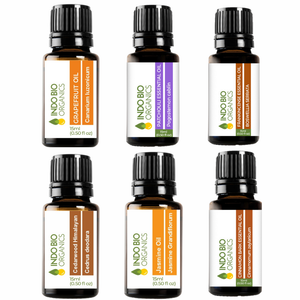
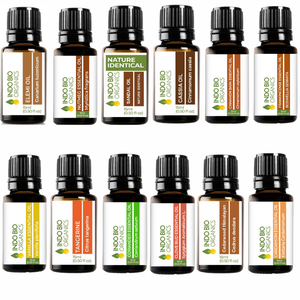
Where can I buy pure tulsi (holy basil) essential oil in Canada? Indo Bio Organics carries tulsi oil within its Natural Essential Oils collection, shipped from within Canada, alongside complementary oils for building your own focus or stress-relief blend.
Bringing It Back Home
Tulsi essential oil doesn't need centuries of spiritual framing to earn a spot in your collection — though that history is real, and worth knowing if you're curious. What it needs is proper dilution, a clear sense of when to reach for it (mornings and stressful stretches, not necessarily bedtime), and an understanding of what makes it chemically different from the basil already in your kitchen.
Used that way, it becomes less of a novelty ingredient and more of a genuinely practical addition to a Canadian wellness routine — especially through the months when a clear head and steady breathing feel hardest to come by.
Explore tulsi (holy basil) and other natural essential oils shipped across Canada from Indo Bio Organics.